

BALTIMORE — A mosque on Harford Road in East Baltimore was engulfed in flames on Sunday evening, Oct. 25, and police took a person of interest into custody at the scene, Baltimore police said. No one was hurt. For Muslims in Baltimore and across the country, the images of a burning house of worship arrive at a time when many congregations are already worried about their safety.
Patrol officers and firefighters were called shortly after 5 p.m. to the 2600 block of Harford Road, in the city’s Coldstream Homestead Montebello neighborhood near Clifton Park, for a reported fire, FOX45 reported. When they arrived, officers found the mosque fully engulfed in flames. Firefighters put out the fire, and officers took a person of interest into custody at the scene, police told CBS Baltimore and WBAL-TV 11 News.
What we don’t know yet
As of Monday morning, officials had not said what caused the fire. “It’s unclear at this time how the fire started on Sunday,” FOX45 reported. Police have not publicly identified the person of interest, and no charges had been announced. Authorities have not said whether they believe the mosque was deliberately targeted, and “no further information was immediately released,” WBAL reported. The extent of the damage, and when worshippers may be able to return, have not been made public. SMF News will update this story as police and fire officials release more information.
More than a building
For Muslims, a mosque is far more than a prayer hall. It is where the community gathers for daily prayers and the Friday congregational prayer, where families break their fast together in Ramadan, where children learn the Quran and the basics of their faith, and where newcomers and elders find a community. When a mosque is damaged, all of that is disrupted at once, and the shock is felt by Muslims well beyond a single congregation.
“Mosques must remain places of community, learning, and prayer,” Corey Saylor, research and advocacy director at the Council on American-Islamic Relations (CAIR), a national Muslim civil rights group, said in September when CAIR and the North American Islamic Trust released an updated mosque safety guide.
Mosque safety in America
Concern about the safety of mosques has grown sharply this year. On May 18, three men were killed when two teenage gunmen opened fire on the grounds of a mosque in San Diego, KPBS reported; the gunmen later killed themselves. CAIR said the men gave their lives protecting worshippers and children.
A month later, a UC San Diego survey of 312 Muslim adults in San Diego found that 88 percent said the shooting made them feel less safe in their community, and 74 percent said they worried more about their personal safety because they are Muslim, KPBS reported. Nearly half said they feel law enforcement does not take threats against Muslims seriously.
In July, CAIR said it had documented 17 incidents targeting Islamic places of worship in May, June and July, a 183 percent increase over the same three months a year earlier, including threats and intimidation. The Muslim Public Affairs Council (MPAC), in a spring security bulletin, assessed the threat of physical attacks against Muslims as “elevated” and reported an elevenfold increase in threats and attacks in March compared with January.
Federal figures capture only part of the picture. FBI hate crime statistics for 2025, released in August, recorded 205 anti-Muslim incidents reported by law enforcement agencies, down from 261 in 2024, according to an analysis by the Arab American Institute. Those numbers depend on what local agencies report, and advocacy groups track many incidents that never appear in police data.
Federal prosecutors have also brought cases. In July, the Justice Department announced federal charges against a Philadelphia man accused of setting a fire with an improvised incendiary device at a mosque in Northeast Philadelphia on July 5. Charges are allegations, and defendants are presumed innocent unless proven guilty.
Resources for congregations
Mosques do not have to face these risks alone. Federal, state and community programs offer funding, training and guidance:
Federal security grants: FEMA’s Nonprofit Security Grant Program pays for security upgrades such as cameras, alert systems, gates, lighting and access control, as well as training. FEMA announced $300 million in fiscal 2026 awards in September to more than 1,600 nonprofits, including Muslim institutions. Nonprofits apply through their State Administrative Agency, not directly to FEMA.
Maryland security grants: In August, the state awarded $10 million in Protection Against Hate Crimes grants to 116 organizations in 16 counties and Baltimore City, with mosques among the recipients, for security personnel, access control, cameras, facility hardening and training. “People want to feel safe when they gather to worship or participate in community activities,” said Dorothy Lennig, executive director of the Governor’s Office of Crime Prevention and Policy.
Montgomery County deadline this week: The county’s FY27 Nonprofit Security Grant offers $1.2 million in total, with up to $15,000 per facility for as many as four facilities. Applications are due Thursday, Oct. 29, at 11:59 p.m.
A new Maryland law: Since Oct. 1, state law makes it a misdemeanor to use force, the threat of force or physical obstruction to interfere with or injure someone lawfully exercising their religious beliefs at a place of worship, punishable by up to 90 days in jail, a $1,000 fine or both.
Free assessment tools: The federal Cybersecurity and Infrastructure Security Agency offers a free Houses of Worship Security Self-Assessment that congregations can use to review their own facilities. CAIR and the North American Islamic Trust’s updated Best Practices for Mosque and Community Safety Guide is written for mosque leaders.
Training in Maryland: CAIR Maryland is holding a free emergency preparedness summit for leaders of mosques, Islamic schools and Muslim organizations on Saturday, Oct. 31, in Ellicott City, covering threat assessment, facility security, coordination with law enforcement and emergency services, and security grants. Advance registration is required.
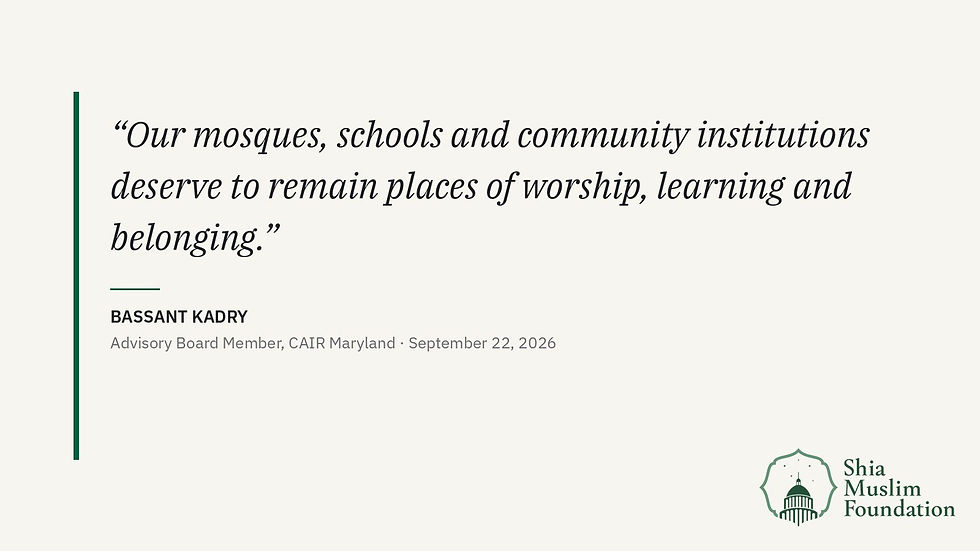
“Our mosques, schools and community institutions deserve to remain places of worship, learning and belonging,” Bassant Kadry, a member of CAIR Maryland’s advisory board, said when the summit was announced.
Practical steps for mosque leaders
MPAC’s security recommendations urge mosques to limit open entrances during prayer times, especially Jumu’ah, keep secondary doors locked and monitored, greet every visitor, keep the grounds well lit at night, make sure cameras are working and recording, keep fire extinguishers serviced, clear brush and flammable materials from around the building, ask local police for extra patrols during prayer times and report every incident, even minor vandalism.
For fire safety, Georgia’s Office of Insurance and Safety Fire Commissioner recommends that places of worship light the exterior and all entrances, trim shrubs and trees so passing patrols can see the building, consider a combined burglary and fire alarm, keep sprinklers and extinguishers maintained, store flammable liquids properly away from sparks or flames, clean kitchen hood filters regularly, avoid overloading outlets and running extension cords under rugs, and report unsafe conditions or suspicious activity immediately.
What to watch
The key open questions in Baltimore are what caused the fire, whether the person taken into custody will be charged, and what investigators conclude about why it happened. Until police and fire officials release their findings, it is best to rely on official information rather than speculation.
Anyone with information can contact the Baltimore Police Department or Metro Crime Stoppers at 1-866-7LOCK-UP.
Sources: CBS Baltimore (Oct. 25, 2026); FOX45 News (Oct. 25, updated Oct. 26, 2026); WBAL-TV 11 News (Oct. 26, 2026); KPBS (June 18, 2026); CAIR (July 28, 2026); CAIR and NAIT (Sept. 16, 2026); CAIR Maryland (Sept. 22, 2026); MPAC; FBI/Justice Department; Arab American Institute; Justice Department (July 2026); FEMA; FEMA (Sept. 28, 2026); Office of Gov. Wes Moore (Aug. 25, 2026); Montgomery County; Maryland General Assembly; CISA; Georgia Office of Insurance and Safety Fire Commissioner.


